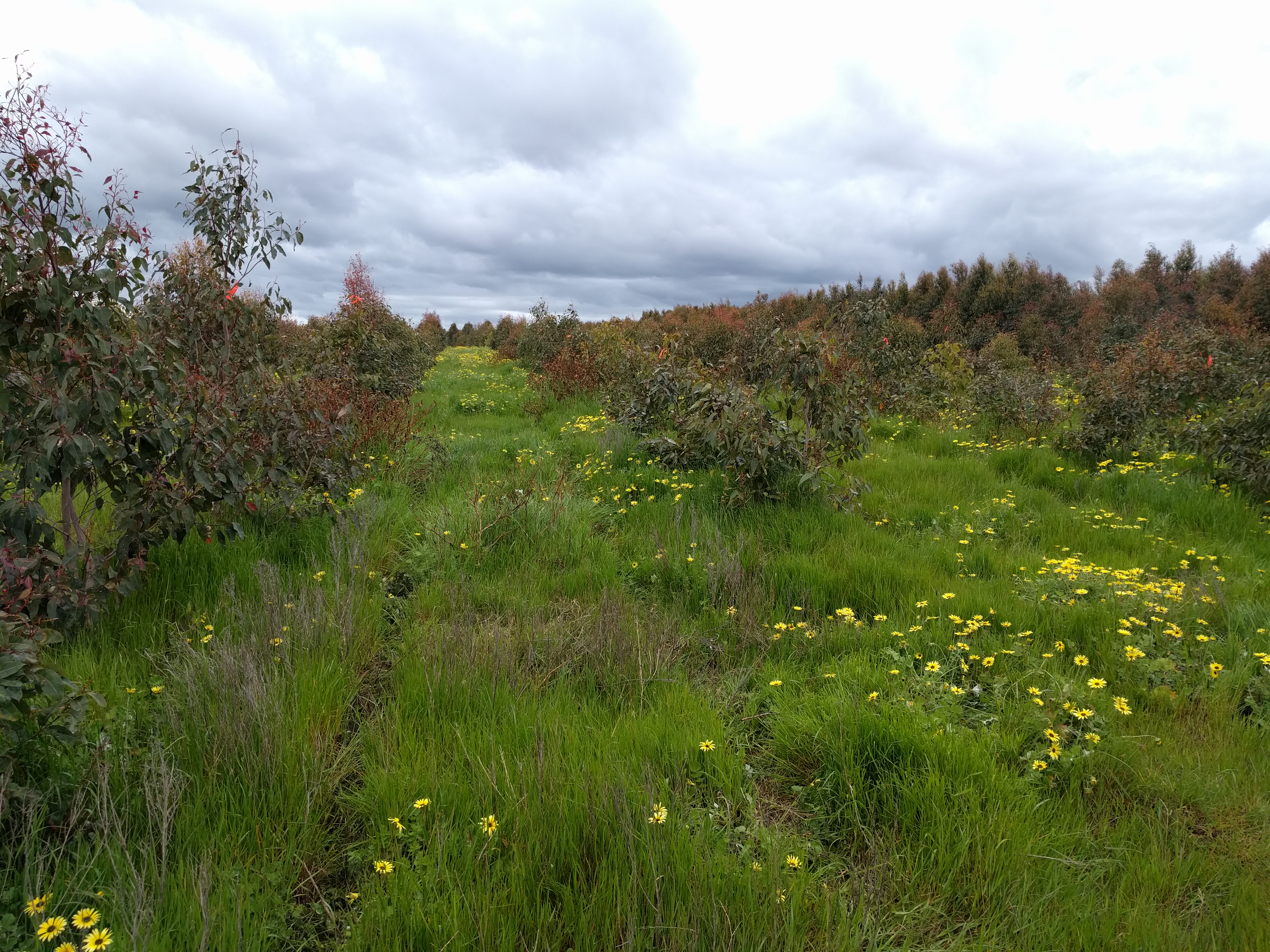
Corymbia calophylla
Genome wide association study (GWAS) – I have identified over 6 million single nucleotide polymorphisms in 450 individuals grown in a common garden. Using classic GWAS approaches, I am trying to identify causal SNPs that explain high amounts of trait variation. I am also using machine learning modeling techniques that predict heritable trait distribution. Collaborators: Dr Paul Rymer (WSU), Prof David Tissue (WSU), Dr Margaret Byrne (DBCA WA), Prof Justin Borevitz (ANU)
Drought manipulation – My colleagues and I have grown 300 or so plants from 12 different populations in a polytunnel. Water treatments were applied using constant sensor measurements and an automatic watering system to maintain two contrasting water regimes (wet & dry) over 6 months. We measured all sorts of traits, including wood density, specific leaf area, vessel diameter, height, basal diameter, above ground dry mass, and rates of photosynthesis. Collaborators: Dr Anthea Challis, Dr Paul Rymer (WSU), Prof David Tissue (WSU)
Heatwaves – We were wondering how temperature alone affects plant performance. We applied two different consecutive heatwaves to eight well-watered populations. We measured the maximum quantum efficiency of photosystem II (FV/FM), the 50% loss of function of photosystem II (T50), leaf temperature, and thermal safety margin (T50-TLEAF). We found some very insightful outcomes. Collaborators: Dr Anthea Challis, Dr Paul Rymer (WSU), Prof David Tissue (WSU), Dr Margaret Byrne (DBCA), Prof Adrenne Nicotra (ANU), A Prof Andrea Leigh (UTS)
Melaleuca quinquenervia
Adaptation to novel pathogen (myrtle rust) – Myrtle rust is novel pathogen to eastern Australia and is heterogeneously afflicting many myrtaceae species. One of them is Melaleuca quinquenervia, but it appears that this species has myrtle rust resistance phenotypes that segregate within populations. This response may be controlled by a small number of genes. Therefore, we are testing this hypothesis by growing thousands of individuals from among and within populations and families, and sequencing a subset of those. We will be able to run quantitative genetics experiments on all of the indivuals and use the GWAS framework to search for causal variants. Collaborators: Dr Jason Bragg (RBGSyd), Dr Richard Edwards (UNSW), Prof Justin Borevitz (ANU)
Adaptation to environment – We have a population genetics style collection of the mothers from the above experiment. We are planning on using whole genome sequencing to look for adaptations to various environmental variables, including salinity and soil water availability. Collaborators: Dr Jason Bragg (RBGSyd), Dr Richard Edwards (UNSW), Prof Justin Borevitz (ANU)
Native grasses
Themeda triandra – I’ve had a long interest in the species Themeda triandra for various reasons. I think it is particularly interesting because it has adapted to nearly all of Australia, it has ploidy polymorphisms, it is important for the rehabilitation of grasslands, and it has potential for food/grain development. I have collected hundreds of individuals from 90 populations, including seed from many of the populations. I have sequenced many of those individuals using reduced representation sequencing. There are many questions that have yet to be answered and hope we get to understand the adaptive mechanisms of this very fascinating species.
Australian grasslands – I am a co-coordinator of the just recently launched Australian grasslands project funded by Bioplatforms.
Student projects
Landscape genomics of jarrah – One student is using 14k SNPs to identify possible variants that are under selection from climatic variables in Eucalyptus marginata. It is a dominant species in the soutwestern Australia biodiversity hotspot, and an important ecologcial component of the forests.
phyloGWAS – A student is working on identifying adaptive signals among Eucalyptus lineages in the sections Exsertaria and Adnataria. More on this as it develops.
Landscape genomics of red gums – A student is finishing their dissertation. They are exploring the interesting adaptive patterns in four different species of red gum eucalypts. Two of them widespread and two of them with restricted distributions. They have recently finished a large water manipulation experiment among the same four species. There are many various aspects to this project and as the results begin being published, I plan on updating this space.
Grassland adaptation – A student has just started their project on understand the population genomics of 8 different species that transition across a steep elevation gradient. They also plan on using genotype-environment association analysis to look for patterns of adaptation and also look for commonalities among those species. These projects are still being developed.
Eucalyptus adaptation to drought – One way to measure how a drought affects plants is to quantify the RNA within the tissue. This tells us which genes are being up- or down-regulated. We can use this information to assess if a species responds to stress events in a plastic or genotypic way. A student is pursuing this line of questioning by comparing pre-drought period, to drought and recovery periods. This time series dataset can provide insight into how different species respond to the same stress events.
Eucalpytus camadulensis
GWAS – I am performing a GWAS analysis using 20k SNPs generated from baits from ~2k gene regions and hundreds of individuals grown in a common garden at Western Sydney University. These bates were developed using whole genome sequencing on hundreds of individuals grown in two different glasshouses. Individuals were segregated based on their phenotypes (∂13C and diameter). These bates are indicative of regions that are associated with important phenotypes. Therefore, we can think of the GWAS results being the ‘best of the best’. This project is still in the early stages of analysis.
Landscape genomics – We are also developing the same baits to look at gene distribution across the landscape. What are driving those patterns? What can we learn from those patterns? How can we harness this information to bolster traits associated with drought resistance?
 Collin Ahrens